
The Sovereign Mark
Why the World’s Greatest Icons Never Followed the Rules
THE HEART OF BRANDING
Nkosana Prince
5/8/20246 min read
Let’s be completely honest for a second.
If you open LinkedIn, walk through a shopping mall, or scroll through any modern branding portfolio right now, you will notice an exhausting epidemic. Everything looks exactly the same. We are living in a sea of corporate sameness. Tech startups all use the exact same clean, soulless geometric fonts. Cosmetics brands all use the same muted beige palettes. Fashion labels are stripping away their heritage to look like identical minimalist boxes.
In the marketing world, they call this "competitor analysis" or "market research."
At Kotei Designs, we call it something else: decorating confusion.
It is a superficial attempt to blend in and compete with businesses that don’t even share your convictions. It’s what happens when you build a business by looking outward at what everyone else is doing, instead of looking inward at who you actually are. It is a default path to safety, and safety is the fastest way to become invisible.
But here is the beautiful irony that the standard marketing textbooks won't tell you: the most iconic, world-altering brands we look up to today—the ones we wear like badges of honor, the ones etched into global culture—never followed the rules. They didn't care about market trends. They didn't run focus groups to see what their competitors were doing.
The founders simply followed their hearts. They did themselves. They stood in the pure weight of their own vision, and they let the world catch up.
Let's look at three stories that prove exactly why real branding isn't about blending in.
1. Apple: The Tech Giant in the Orchard
Imagine it’s the late 1970s. You are launching a company that builds highly complex, deeply technical microcomputers. The industry around you is cold, sterile, and hyper-corporate. Your competitors are naming themselves things like International Business Machines (IBM), Hewlett-Packard, and Digital Equipment Corporation. Their logos are rigid, industrial, and filled with tech jargon, lines, and circuit-like abstractions.
What do you do to fit in?
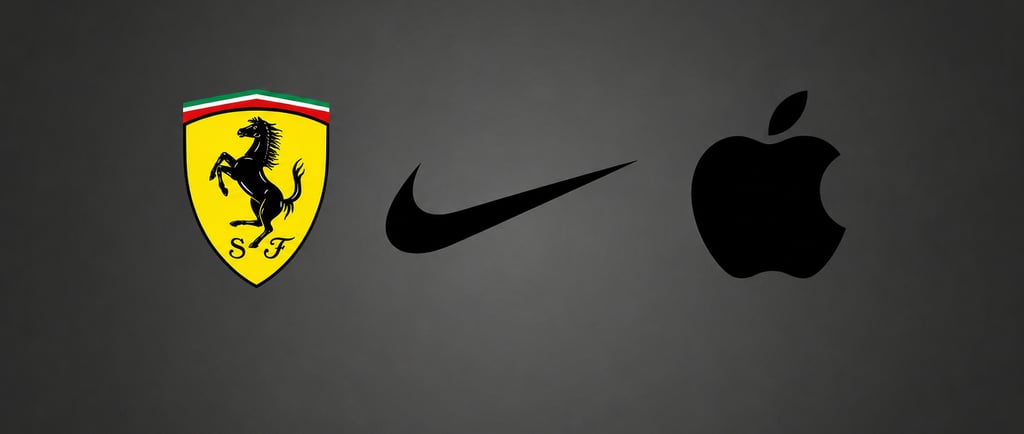
If you are Steve Jobs, you don't fit in. You name your computer company after a piece of fruit. And you don't choose a logo that shows a microchip, a monitor, or a line of code. You choose a simple, stark silhouette of an apple with a bite taken out of it.
From a traditional market research perspective, it made absolutely zero logical sense. An apple has nothing to do with computing. It doesn't communicate "efficiency," "software," or "data processing."
But Steve Jobs wasn't trying to decorate corporate confusion. He understood that technology at the time was intimidating, frightening, and cold to the average human being. He didn't look at IBM to copy their homework. He looked at his own vision: a desire to make computing warm, approachable, simple, and human. The apple was a symbol of discovery, simplicity, and nature.
By refusing to look at the competition, Apple created a visual mark that didn't just stand out—it completely redefined what a technology company could be. They didn't sell a machine; they sold a philosophy.
2. Ferrari: The Ghost on the Shield
Now, let's step onto the racetrack and talk about the Ferrari logo. The legendary Cavallino Rampante—the black prancing horse on a canary yellow shield.
If you ask a modern brand consultant to design a logo for a high-performance sports car company today, they will deliver a sleek, aerodynamic abstract symbol meant to evoke speed, airflow, and mechanical precision. They will analyze competitor colors and talk about "forward momentum."
Enzo Ferrari didn’t do any of that. The Ferrari logo wasn't born out of a marketing strategy; it was born out of raw emotion, grief, and a profound commitment to legacy.
During World War I, there was a brilliant Italian fighter pilot named Count Francesco Baracca. He was a national hero, an ace of the skies, who painted a black prancing horse onto the side of his airplanes. In 1918, Baracca was shot down and killed in action, leaving behind a legacy of immense bravery and heartbreak.
Years later, in 1923, a young Enzo Ferrari won a race at the Savio track in Ravenna. In the crowd that day was Baracca’s mother, the Countess Paolina. She approached Enzo and made a deeply personal, emotional request. She told him to take her fallen son’s prancing horse emblem and place it on his race cars. She said, "Put it on your cars; it will bring you luck."
Enzo didn’t look at what other automotive manufacturers were doing. He didn’t care about what was commercially viable or trendy. He accepted the emblem as a sacred token of honor, keeping the horse black as a symbol of mourning for the fallen pilot, and adding the yellow background to represent his hometown of Modena.
The Ferrari logo is essentially a tombstone, a monument, and a living piece of history all captured in a single frame. It commands absolute authority because it carries the weight of a real human story. It wasn't designed to sell cars; it was designed to carry a soul.
3. Nike: The Mark That Had to Grow
We are told by modern "experts" that a logo must be a stroke of instant genius. It must be universally loved by the boardroom on day one, perfectly encapsulating the global future of the enterprise in a single glance.
Enter Phil Knight, the founder of Nike.
In 1971, Knight was a stressed entrepreneur trying to launch a new line of soccer and running shoes under a tight production deadline. The factory in Japan was waiting for the graphic so they could start printing the shoe boxes. Out of pure desperation, Knight walked down the hallway at Portland State University, found a graphic design student named Carolyn Davidson, and asked her to create "a stripe or a graphic" that conveyed movement.
Davidson spent a few days drawing lines on tissue paper. She presented a few concepts, one of which was a simple fluid checkmark—what we now know as the Swoosh.
Phil Knight looked at it, shrugged his shoulders, and famously said:
"I don’t love it, but it will grow on me."
He paid her $35, put the graphic on a plane to Japan, and went back to work.
Nike didn't spend millions of dollars analyzing consumer psychology or tweaking angles to match their competitors. The founder didn't even like the logo initially. But they didn't freeze up, and they didn't try to imitate the established German giants who dominated the sportswear industry at the time. They committed to it.
The Swoosh didn't become iconic because it was magically perfect on paper. It became iconic because of how Nike behaved over the next fifty years. They backed that simple, unloved mark with relentless discipline, world-class craftsmanship, and an unwavering belief in the human spirit. They lived out their identity so consistently that the mark had to grow on the entire world.
The Reality of Your Vision
What can we learn from a piece of fruit, a fallen pilot's emblem, and a $35 checkmark?
We learn that the market research handbook is a trap. When you spend all your time researching your competitors to see how you should look, you are assuming that your competitors actually know who they are. Most of the time, they don’t. They are just as confused as you are, looking at someone else, who is looking at someone else. It is a loop of endless imitation.
If you want to build a brand that commands true authority, that charges premium value, and that leaves a lasting legacy, you have to stop looking at the noise outside.
What is real is not your temporary market struggles or your immediate profit margins. Reality is the pure weight of the vision you carry—your hopes, your dreams, and the underlying intent behind everything you build.
Your identity must precede your growth. You must have the courage to discover who you are internally before you try to express anything externally. If your brand is born out of true self-discovery and executed with absolute, unyielding discipline, you won't need to worry about the competition.
Because when you are completely, unapologetically yourself, there is no competition.
Stop decorating confusion. It’s time to uncover something real.
Are you ready to stop blending in? At Kotei Designs, we don't follow trends, and we don't design blindly. We partner with expressive, ambitious founders to strip away the noise and discover the enduring structure of their brand's true identity.
If you are ready to move from confusion to absolute clarity, let's begin the work.
Connect
Questions? Reach out anytime, we're here.
Call
info@koteidesigns.site
+27 78 923 6459
prince@koteidesigns.site
© 2026. All rights reserved.
REFUND POLICY
PAIA